Saturday, November 10, 2012

Empire of Barbarians

-->
Strong, powerful, and grand were the first words that came to my mind when I read the word empire.  An empire, in my opinion, is an organized system in a society where everyone works together for the greater good of their empire. These empires are lead by a robust, courageous and knowledgeable leader.  The first great empire that comes to mind is the Roman Empire one of the greatest and longest lasting empires known to man.  Some of the best thinkers and inventors came from this empire-helping advance our world to what it is today. Not all empires are as positive, such as the Nazi empire.  Hitler took advantage of and manipulated a poverty stricken society desperate for help. Millions of innocent people lost their lives and created racial tensions that still exist today. 
            Everyone is a part of an empire in one way or another.  The government is similar to an empire; even the educational system is an empire.  One self serves a purpose in their empire so that it can remain running smoothly.  Each person performs a task for the greater good of the empire.  Those who do not perform their functions within an empire may be considered an other because they are not helping the empire be the best that it can be. 
            Barbarians on the other hand, are uneducated human beings; they are violent, live in caves and hunt for their food to survive.  The first humans on earth were barbarians that slowly but surely learned from the world around them and each other and were able to invent things to make their everyday lives easier leading to how we are today. I got these ideas from history and observing the world around me.  There are various movies and televisions shows about empires and barbarians even empires of barbarians. 
The word "empire" to me makes me think of big corporations. It also makes me think of New York City and all the tall buildings of businesses that are there.  I feel as though this thought of mine has come from the song "Empire State of Mind". In this song the artists are referring to NYC.  Empire makes me thing of a group where there is a leader with many people working together for the same reason.  I also think of a group dominating in power, so much strength that nothing could possibly bring it down. Empire can relate to the "other" in the sense that if you are not one of them, you are the "other".  You do not belong if you can not conform to the group of people who are dominating with lots of power and control.  To be the "other" you are the underdog with little power and authority.

When i hear the word barbarians i think of cave men.  The men who are very uncivilized, have no manners, and are doing everything for the first time.  I also think of a man discovering fire and learning how to cook food.  Barbarians could also just be people who are very uncivil and live and act like people did long ago, with no innovations or knowledge of what to do.
I think my ideas about empire and barbarians came from the media and social networking.  People try and make you think of a word how they think you should see it.  I am sure many companies try and use specific terms such as empire to make you think about how much power they have.  Words come with a background and the first thing you think of is the last thing you remember to do with that word.  I recently watched one of my favorite movies, Encino Man, which made me think of cavemen when it came to the term barbarians.  It's all up to the persons perspective and what kind of media has influenced them the most.  

Tuesday, October 23, 2012

If poetry is worth studying, then why not science fiction?

photo sourc
Science fiction belongs in the literary canon just as much as other genres because particularly good examples of science fiction writing can elucidate cultural anxieties and make predictions that serve as warnings. Science fiction is literature and has influenced culture just as much, if not more, than other genres. Like the romance genre, the science fiction genre has been stigmatized by poorly-written, pop literature, though many science fiction books have shown to be semi-accurate portrayals of societies progression along its trajectory. The cultural anxieties that science fiction novels address may not be relevant years later, but a well written science fiction novel may serve as a warning to people of what could result if things continue to progress as they have. 

In Do Androids Dream of Electric Sheep?, Philip K. Dick shows readers the potential dangers that would society face if a world-wide nuclear war broke out. The fallout alone would render the Earth unlivable, or at least unlivable without major adaptations to lifestyle. Dick also shows what could happen to human experience and emotion if humans continue to suppress real feeling through unnatural methods, such as drugs or treatments. Another example of valuable science fiction is Mary Shelly’s Frankenstein, in which Shelly, through the suffering caused by Frankenstein’s creation, shows the ways that uses of technology and science can cause unintended consequences. While today Shelly’s monster (a man made through stitching together pieces of dead bodies brought to life through lighting) seems unthreatening due to its unrealisticness, the story certainly warns of unintended side-effects of meddling with nature. Additionally, though aliens have yet to pose a problem for earth-dwellers, The War of the Worlds by H.G. Welles was far ahead of its time in it’s predictions about technological advances.
From Plan 9 from Outer Space, photo source
As in any genre, bad or poorly written works are present, and perhaps due to the future-thinking nature of science fiction writing, more bad examples may be found simply because the problems that they predict are too far-fetched and unbelievable. However, believability is not a requisite for crafting a good novel, and perspective and preference will determine who thinks what work is good or bad and in which ways. What the better examples of science fiction writing may offer are clues about cultural anxieties and potential outcomes to present problems.
As a side note, many of the "bad" examples of science fiction have inspired cult followings and will be remembered as classics for other reasons, though this trend seems to be more present in movies than literature. A classic example of awesomely awful sci-fi is Plan 9 from Outer Space. I doubt it's creators had any idea the impact that their film would have on cinefiles.

Sunday, October 21, 2012

A Defense for Science Fiction as Literature


Blogging later rather than sooner certainly has its consequences, because like many of my classmates, my first reaction to this question was to cite famous literary works, such as George Orwell’s novel, 1984. I would like to hear why some scholars think that Sci-Fi should not be included in the literary canon. You don’t have to read Marriam-Webster’s definition of literature; you know what literature is. You know what it does. Literary works explore all kinds of interpersonal relationships, between people, the world, and society. Does the Science Fiction genre not explore these same relationships? That was a rhetorical question.
Science Fiction may not be grounded in this world, so to speak, but that is the beauty of the genre. Literature, for many, is an escape from reality. Scholars may argue that the differences from reality deem Sci-Fi as deficient, but I argue that these differences give it complimentary qualities. Philip Dick’s novel makes it difficult for readers to differentiate between real and unreal; isn’t this an important real-life differentiation? From a psychological perspective, the Sci-Fi genre of literature may shed light on psychosis, a break from reality which characterizes Schizophrenia. Not only can this genre provide readers with perspective on psychosis, but can even serve as a self-diagnosing mechanism. Hear me out: If I ever start to think or act like some of the characters in a Kurt Vonnegut novel, seeking therapy might be a good idea.
Science fiction contributes a futuristic tone to literature that fiction just can’t accomplish as successfully. Using Fahrenheit 451 as an example, Sci-Fi makes readers ask, “Is this where our world is headed?” Just because the settings or plots in these stories may not seem plausible at the time does not necessarily translate them into an impossible realm. For example, Bradbury, in a way, foreshadowed the scare of Communism by about twenty years. Will we have electric sheep for pets in the year 2021? Nobody knows what the future holds, and Sci-Fi writers use their imaginations and creativity as an attempt to describe some future scenarios. In my opinion, this genre is absolutely important and should be taught in colleges and analyzed by scholars. 

No Limitations

Via San Ved Tap Keeper

Does literature have a set definition?  For me, I think of literature as any type of text that can be read  whether for analytical purposes or for entertaining purposes.  According to this definition, science fiction would definitely be considered literature.  Now whether it fits into someone’s “literary canon” on the other hand is debatable.  I don’t see why it couldn’t be seen as important enough to be looked at in a scholarly manner.  Not all books studied on an educational level are one hundred percent non fiction.  If you’re going to analyze something such as literature, you should analyze it in its entirty, not just selective parts of it. 
Also, the fictional events that take place in a science fiction novel could actually be metaphors used to represent another event that was going on at that time in history.  Even if the science fiction antics are completely left field and don’t have any deeper meaning than random creation, it doesn’t make this literature worth any less than other literature.  In my opinion it’s better.  It’s more entertaining and if analyzed it would probably tell you a lot more about the author of the text and his or her creative backgrounds.  With science fiction writers literally have no limitations, whereas in other genres they are limited by rationaliy and reality. 
If I personally wanted to read and or study a book, and I was given the choice to analyze either Frankenstein or  Jane Eyre, I would choose Frankenstein every time.  At the same time I’m not excluding Jane Eyre as not being “real literature” either.  I’m simply saying I prefer one genre over the other.  Whether someone else see’s the genre as being worthy enough to be studied is one thing, but to not even consider a text literature isn’t possible.  I don’t see where the argument can be made against any genre.  Literature is a big category with many subcategories within it.  It cannot be labeled as one thing.

SciFy

             Is science fiction true literature? In all honesty, I can not give a valid opinion on this topic because I have not read a science fiction story of my own choice before. I have only read what has been assigned in this class. Even though I do not know much about science fiction, I do think that it can not be discounted as literature.
             How can science fiction be discounted as literature, when there is no exact definiton of literature? Broadly defined literature is the written or spoken word. So, literature is what an audience wants it to be. Different audiences like different genres of litearture. An audience can like romance, history, mystery, etc. Now what makes these genres of literature different than science fiction? Not much from what I know, they all contain characters, settings, and plots. All thats different is the names, places, and how the plot is written. It seems that the genres all contain a similar design including science fiction. 

Scify
        Science fiction is a wierd genre to me but it does not make it anyless important as literature. When I think of science fiction, I think of The War of the Worlds by H.G.Wells with robots, future, and world destruction. With what little I know these ideas are what I generally assume science fiction is. The movie was good, so I can assume the novel was much better, so how can people who do not like the genre say its not real literature.
         The quote "Beauty is in the eye of the beholder" seems to hold true here. Some people like science fiction and others do not. It is not up to some literary scholars to say that science fiction is not true literature because they do not like it. Everyone who reads literature has their preference and science fiction has people who prefer it. With people reading science fiction, I think that is what makes it literature.

Science Fiction in Literature


Science fiction introduces and discusses ideas, as any form of literature would do.  Behind the stories lies a deeper meaning, exploring events of the present as well as the past and future.  Science fiction is a form of literature, as literature is a written work representing a language or people.  The author’s background also contributes to the meaning of the text as we interpret his/her message through reading. All forms of literature are important because they affect us in different ways, speak to us, and they are universal.  Writer Robert Stevenson says, “The difficulty of literature is not to write, but to write what you mean; not to affect your reader, but to affect him precisely as you wish.”
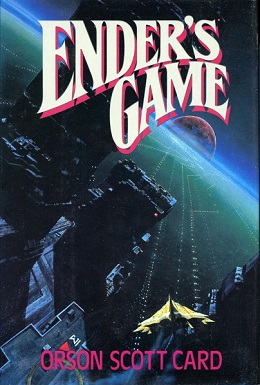
Ender's Game
Ender’s Game, published in 1985, is a science fiction novel written by Orson Scott Card.  In this novel, young talented children are taken to a training center in order to prepare for an invasion that is to occur again.  Ender Wiggin, the youngest child, is seen as a smart and strong leader and carries his team above and beyond.  While Ender wins all of his “games”, he doesn’t realize how much of an effect these games have on his real life, as he begins to confuse what is real and what is not.  While the novel takes place in the future, it shows how reliant we become on computers and how difficult it can be to distinguish between computer games and reality.  Politics is also included in the novel, as the children must find a way to outsmart the controlling and manipulative adults.  Ender represents good and innocence because he continues to keep his positive attitude and understands even his enemies.  With his kind ways and the sacrifices he makes, he brings on an optimistic attitude that is able to deliver the message of the story, that people must be forgiving and see the good in others.

I think that science fiction is true literature and it belongs entirely.  Science fiction holds content from various settings and ideas.  As we look into the text we can learn more about reality, although it isn’t always addressed directly.  It is just as literary as other types, such as romantic, political, comic, and detective literature.  This is true because just like the others, it is able to express itself and tell a story, all while influencing the mind of its readers.